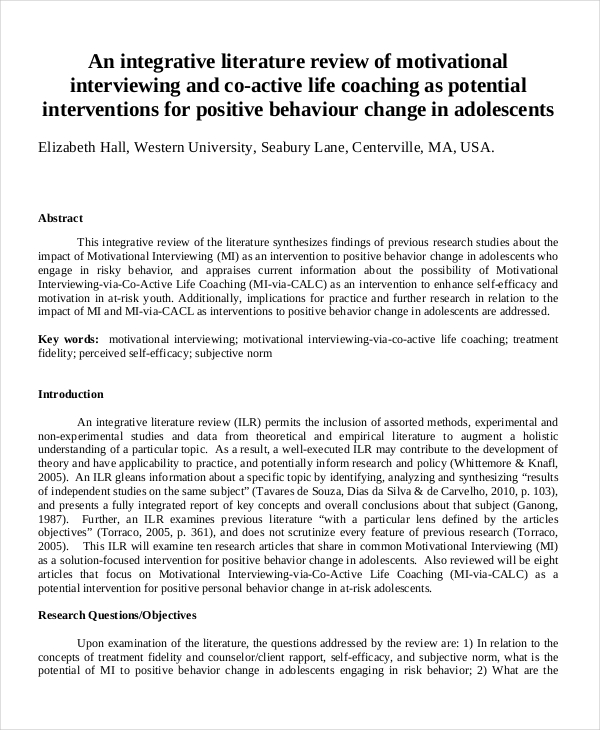
· Sample papers. Critical Literature Review Paper. Post author By kean; Post date February 4, ; The topic is Ethical issues regarding personal relationships. I am attaching a word document as well which has some information on it that will be helpful for this paper. 12 to 15 page (does not include title page or references), double-spaced review of the literature paper focused on an Literature Review Template Definition: A literature review is an objective, critical summary of published research literature relevant to a topic under consideration for research. Its purpose is to create familiarity with current thinking and research on a particular topic, and may justify future research into a previously overlooked or understudied area. A typical literature review consists A literature review is a survey of scholarly sources that provides an overview of statement or the study’s goals or purpose. *This sample paper was adapted by the Writing Center from Key, K.L., Rich, C., DeCristofaro, C., Collins, S. (). Use of P ropofol and emergence agitation in children: A literature review. AANA Journal, 78(6 File Size: KB
Critical Literature Review Paper - Academicscope
We use cookies to enhance our website for you. Proceed if you agree to this policy or learn more about it. Type of paper: Essay.
Topic: NursingAliensStudySurgerycritical literature review sample, MedicineStaycritical literature review sample, DisasterRecovery. Early ambulation is now recognised as an intervention that confers many positive benefits to patients following cardiac surgery. However, there is lack of clarity as to the optimum time for the patient to perform early ambulation. A focused question was developed to ascertain whether early ambulation within 24 hours after extubation is more effective compared to ambulation 24 hours or more following extubation.
The clinical question guided the search and retrieval of 6 studies that were subsequently appraised. There are benefits and many limitations of the chosen studies and do not critical literature review sample sufficient evidence to answer the clinical question definitively. A more refined question is proposed. The conventional postoperative management of cardiac surgery is to have the patient remain on bedrest for days at a time critical literature review sample ensure rest and healing.
However, there is increasing recognition of the benefits of mobilisation early in the postoperative period. A decline in the risks for complications is associated with shorter hospital stays and maintenance of functional ability without the need for rehabilitation. Changes have since been made in clinical practice to enable early ambulation so that patients can optimise the benefits.
Extubation is performed earlier, and the patient care involves the performance of progressive mobility exercises. The second postoperative day entails transfers thrice a day, ambulation times a day, incentive spirometer, coughing, and deep breathing. Even patients with mechanical circulatory support devices are supported to mobilise early. However, there critical literature review sample controversy in relation to how early the early ambulation is.
Evidence-based practice warrants that guidelines or protocols be based on available research evidence, clinical experience, and patient preferences rather than an arbitrary decision Stevens, A focused question was developed to ascertain the state of evidence and what additional research needs to be done.
The chosen population is adult post-cardiac surgery patients, and the intervention is early ambulation at less than 24 hours following extubation. It will be compared to early ambulation 24 hours post-extubation. The selected outcomes are wound status, early recovery, and vascular critical literature review sample. A structured search of the literature was conducted in the following databases: PubMed, Science Direct, CINAHL, Cochrane, and Medline.
These key words guided the search: post-cardiac, post-heart, critical literature review sample, surgery, early, critical literature review sample, ambulation, mobilisation, less, than, more, than, 24 hours, after, extubation, recovery, wound, circulation.
The results were ranked according to relevance and limited to peer-reviewed journal articles in the English language published within the last 10 years or beginning in The titles were browsed and if deemed related to critical literature review sample clinical question, the abstract was reviewed to ensure its relevance to each element of the question. If filtered results exceededonly the first articles were considered for abstract review.
The best articles in terms of relevance and research design were retrieved with greater preference placed on systematic reviews, randomised controlled trials RCTsquasi-experimental studies which are typically within a quality improvement framework, and cohort studies, critical literature review sample.
If lacking, descriptive case studies were also considered. The combined search of the CINAHL and Medline databases with filters yielded 4, results. A review of the first articles led to the retrieval of 3 articles.
The search of PubMed lead to results and the retrieval of 2 articles after duplicates were removed. In the Science Direct database were results with the retrieval of one article after duplicate removal. One article was retrieved from the Cochrane Database bringing the total articles chosen for the review to 6. One is a systematic review, 3 were QI or non-QI quasi-experimental studies, one was a non-randomised trial, and one was a randomised prospective trial.
There remains a paucity of research on the topic given the turnout of relevant articles. Camp et al. A description of the new protocol that was implemented was described and included weaning the patient from the ventilator and incentive spirometry and early ambulation within the same day as extubation.
Prior to this, ambulation was done the day after extubation. Staff adherence to the protocol was ensured through education and training. The defined outcomes were sepsis, pneumonia, length of stay in the ICU, hospital length of stay, reintubation, and ICU readmission. These outcomes are proxy indicators of patient recovery. A large sample of patients was in the post-intervention group while 1, critical literature review sample, participants were in the pre-intervention group Camp et al.
Surgeries included CABG, valve repair, or a combination of both. The results show that the post-intervention group had a lower rate of complications, namely pneumonia and sepsis, and reduced lengths of stay in the ICU and the hospital overall Camp et al.
Furthermore, there was a lower risk of reintubation and ICU readmission. The outcomes reflect speedier recovery when patients are extubated earlier and ambulated within 24 hours compared with delayed extubation and ambulation.
Murphy et al. Extubation and mobilization via sitting are performed within postoperative day zero. Again, this outcome is a proxy measure of recovery wherein shorter stays are associated with reduced complications including DVT and pulmonary embolism.
The results also show a reduction in the median length of hospital stay from 9 days before protocol implementation down to 5 days after implementation. Albeit not a Critical literature review sample study, Ahmed critical literature review sample al. Early mobilisation included repositioning the patient in bed, early ambulation through bed-to-chair transfers and walking, and chest physiotherapy. An even smaller sample was used — 20 patients for the pre-intervention group and 20 patients for the post-intervention group.
All underwent open heart surgery. The results demonstrated earlier critical literature review sample recovery in the early ambulation group with lower rates of dysrhythmias and atelectasis. Also noted in this group is a significantly shorter ICU length of stay implying earlier recovery from a critical status. However, no differences were found in relation to hemodynamic, oxygenation, and renal parameters.
Meanwhile, Kandasamy et al. The outcomes include recovery, ICU length of stay, and length of hospital stay, critical literature review sample. The ultra-fast track group was extubated less than 3 hours post-surgery while the conventional treatment group were extubated more than 3 hours post-surgery.
Patients who were unstable were excluded from participation. The premedication, extubation, and other postoperative interventions that was standardised to all study participants was described. Overall, the ultra-fast track group had shorter ICU and hospital lengths of stay with fewer hours on ventilation Kandasamy et al. However, the conventional treatment group had a greater number of patients with pulmonary arterial hypertension PAH which could be a source of bias.
Otherwise, the 2 groups are statistically similar in terms of demographic attributes. A multifaceted intervention that begins in the intraoperative period is seen to have contributed to the positive results.
The use of titrated short-acting anaesthetics, maintenance of normothermia in the postoperative period, administration of appropriate analgaesics, critical literature review sample, early extubation, early ambulation, and promotion of the return of alimentary functions collectively contribute to early recovery Kandasamy et al.
Hoque et al. Forty adults who underwent cardiac surgery were allocated either to the total intravenous anaesthesia TIVA group or to conventional anaesthesia. Except for the choice of anaesthesia, all other treatment related factors were kept similar to reduce bias between the TIVA and conventional anaesthesia groups. The depressant effect of TIVA is shorter in duration than more long-acting conventional anaesthesia making it possible to perform early extubation and ambulation within 24 hours on postoperative day zero or day 1.
On the other hand, overnight mechanical ventilation is often necessary when conventional anaesthetics were used. Extubation followed when the patient met the criteria for eye opening, muscle power, respiration, haemodynamic indicators, pain level, and presence or absence of bleeding.
The results demonstrate better respiratory and haemodynamic critical literature review sample following extubation and ambulation in the TIVA critical literature review sample compared with conventional anaesthesia.
The outcome is an indirect indicator of recovery as it reduces the risk of reintubation and longer cardiac ICU stay. In a systematic review, Zhu, Lee and Chee aimed to determine the impact of fast-track interventions in the post-cardiac surgery period on mortality as well as postsurgical complications and length of stay in the ICU and hospital. Comparison interventions were conventional or non-fast track care, critical literature review sample.
Interventions were early extubation, early ambulation, and the use of low-dose opioids for general anaesthesia during the intraoperative period. Early extubation and ambulation typically occurred within postoperative day zero.
Patient surgeries included CABG and valve replacement. Complications included wound infection and major bleeding. The aggregate sample size of the studies was 4, patients, and most trial samples involved low- to moderate-risk patients. However, patients on fast-track care were noted to have shorter ICU stays indicative of lower risks for critical illness.
The findings also show that fast-track care leads to similar outcomes as conventional care in low- to moderate-risk patients but at a lower cost. The strength of the evidence is the integration of early ambulation within 24 hours following extubation into a multifaceted intervention such as fast-track protocols. This recognises the complex nature of post-cardiac surgery outcomes in that there are many factors that shape the clinical consequences.
Indeed, if the patient remains heavily sedated then extubation cannot be performed. In addition, Kandasamy et al. The quasi-experimental QI approach of Camp et al. For instance, critical literature review sample, Camp et al. There are limitations to the evidence, however. Therefore, it is difficult to draw conclusions on effectiveness in relation to many of the outcomes when considering the entirety of the evidence, critical literature review sample.
Another limitation of the evidence is the conduct of studies in single centres. It may be difficult to generalise the findings of one hospital in Bangladesh as in the study by Hoque et al. The randomised trial by Hoque et al. Only the study by Camp et al. These factors reduce the quality of the studies.
How (Why) write Critical Literature Review (L1) - Why Literature review?
, time: 13:46School essay: Example of a critical review
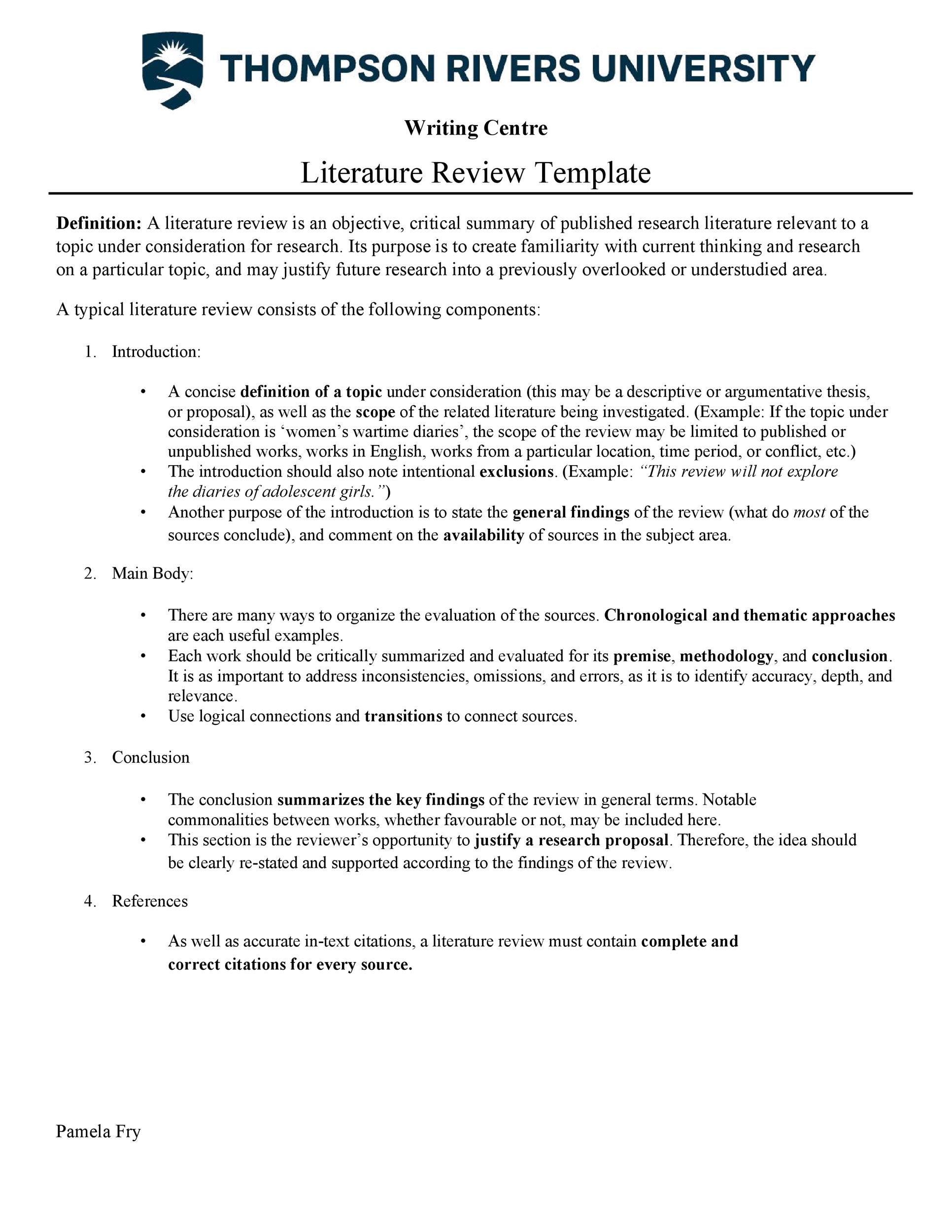
· Sample papers. Critical Literature Review Paper. Post author By kean; Post date February 4, ; The topic is Ethical issues regarding personal relationships. I am attaching a word document as well which has some information on it that will be helpful for this paper. 12 to 15 page (does not include title page or references), double-spaced review of the literature paper focused on an 2 days ago · Example of a critical review. Feb 11, · Literature Review Examples. Usually, a literature review can be described as an objective, concise, and critical summary of published research literature pertinent to the subject being researched in an article. A literature can be an end in itself (an analysis of what is known about a topic) or a prologue to and rationale for engaging in Dec 06 · Usually, a literature review can be described as an objective, concise, and critical summary of published research literature pertinent to the subject being researched in an article. A literature can be an end in itself (an analysis of what is known about a topic) or a prologue to and rationale for engaging in primary research


No comments:
Post a Comment